Guide

Top 25 Video Production Companies in the United States
Find the best video production marketing company for your brand in 2026. Compare top agencies for video strategy, production, engagement, and sales.

Written By:
Kenneth James

Find the best video production marketing company for your brand in 2026. Compare top agencies for video strategy, production, engagement, and sales.
Written By:
There are thousands of video production companies operating in the United States, and most of them can make something that looks good. That was true in 2022 and it is even more true now that AI tools have dropped the floor on production quality. Looking good is no longer the differentiator.
What separates the companies on this list is what happens before and after the camera turns on. Who is defining the audience. Who is writing to a business goal instead of a creative brief. Who is still around six months later when you need version two, a paid cutdown, and a report on what actually converted.
We rebuilt this list from scratch for 2026. Ten companies from the original version came off, either because they closed, went quiet, or turned out not to be American at all. Ten new ones came on.
Ranking leans toward companies that can carry a project from strategy through production and into distribution, because that is where most video budgets leak. A great film that nobody sees is an expense, not an investment.
Sandwich more or less invented the modern tech launch film. They started by accident in 2009, made a video to promote their own app, and the video outperformed the app. Seventeen years later they are still the studio Silicon Valley calls when a complicated product needs to feel human, with recent work including a Perplexity spot starring Jim Harbaugh and a campaign for Robot.com shot on Blackmagic's immersive cine system. They have also drifted into building their own products, launching a Mac app called Hovercraft in 2026 and spinning up a visionOS studio. That range is unusual, and it shows in the work.
Harmon Brothers built their reputation on Squatty Potty, Purple, and Lume, ads that were funny enough to be shared and structured enough to sell. Their claim of more than 1.5 billion views and hundreds of millions in client product sales is self reported, but the cultural footprint is real and easy to verify. Worth knowing before you call: the company is now led by CEO Shane Rickard rather than the founding Harmon brothers, several of whom moved on to other ventures. The formula and the team that executes it are still in Provo. Their most recent public campaign was for the Utah Lake Authority in 2025.
ThinkRaven is a creative agency that has been making video for fifteen years, with roots in San Diego and a team now anchored in Austin. The distinguishing move came recently: rather than handing finished creative to somebody else's media buyer, they started running the paid media themselves.
That closes the loop most video companies leave open, where the film gets delivered and nobody can say whether it worked. Recent client work spans consumer packaged goods with IQBAR and Neutonic, enterprise technology with webAI, and workforce brands including DailyPay. The pitch is not prettier pictures. It is video that has a number attached to it.
Bottle Rocket had the most active 2026 of anyone on this list. They marked their fifteenth anniversary with a stop motion campaign deliberately positioned against AI generated creative, which got picked up on the wires in June. The awards shelf backs the swagger: a Daytime Emmy, a Webby nomination, and Gold and Silver Tellys for their Basis work, on top of more than twenty Tellys cumulatively. They have also built out an AI search and answer engine optimization practice, which is a smart read on where video discovery is heading. Full service, Fulton Market based, and genuinely busy.
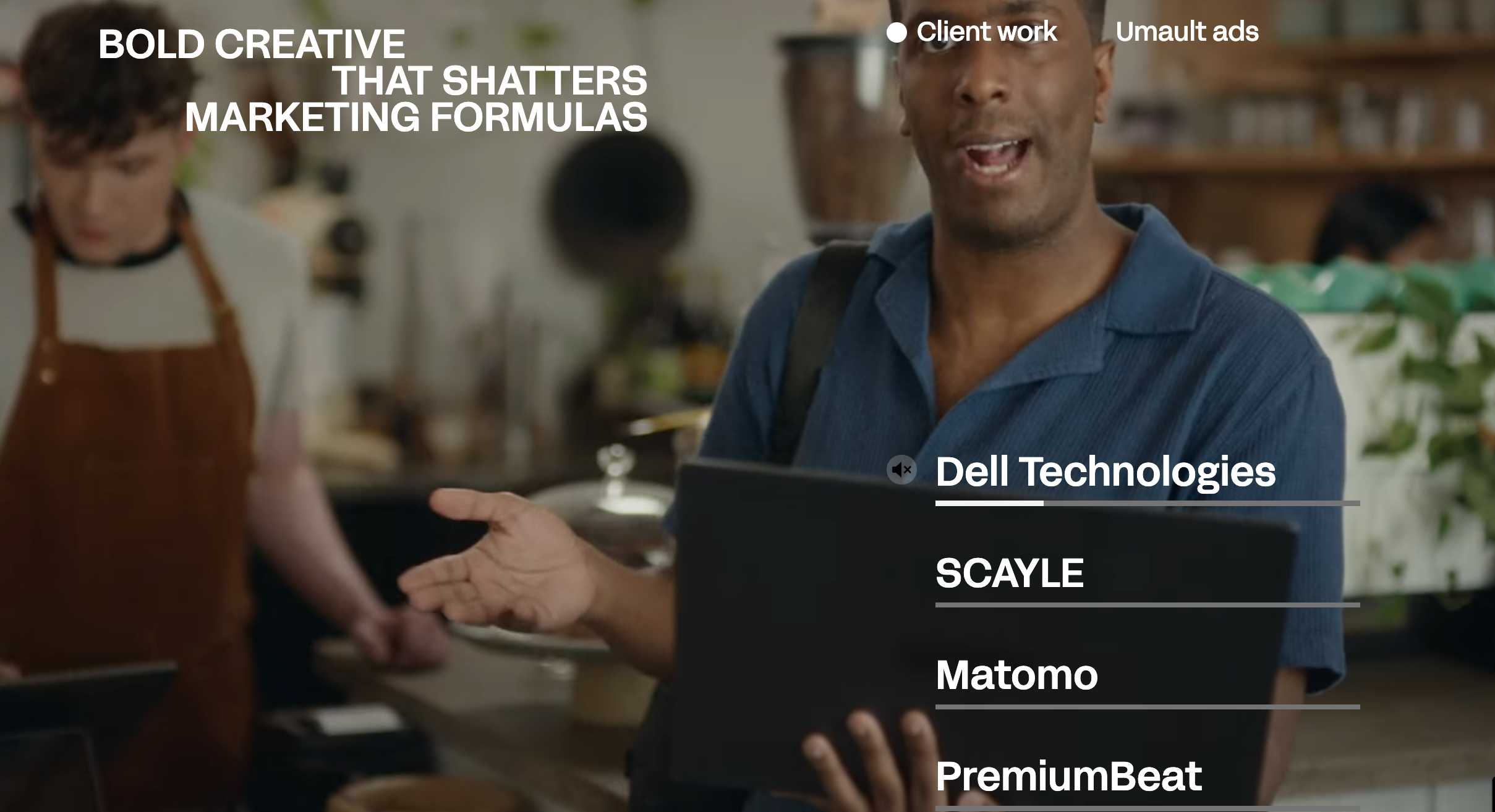
Most B2B video is unwatchable and everybody knows it. Umault's entire premise is that business buyers are people who would also rather laugh. Their Matomo film "Googleheimer" cleared a million views in its first week, and their Teamwork.com piece "The Client" hit 7.5 million impressions with LinkedIn engagement roughly seven times the platform benchmark. They picked up a Webby nomination in 2024. Small shop in the Chicago suburbs, and founder Guy Bauer writes thoughtfully about where AI fits in video production. If your category is boring, that is an argument for calling them, not against it.
Storyfarm carries the heaviest hardware on this list. A National Emmy, sixteen regional Emmys, a Peabody, and a duPont Columbia award, which is journalism level recognition rarely seen at a commercial video shop. Founder John Sherman came out of broadcast news and it shows in the interview work, which is noticeably better than the category average. They were named a Clutch Top Video Production Company in the United States for 2025 and have since added dedicated AI and consulting service lines. Small team, roughly five core people plus contract crew, so they are selective about what they take.
Hornet is the rare studio whose award record you can verify on the awarding body's own site, which after auditing two dozen companies I can tell you is not common. They took a Gold Cube and Best of Discipline at the 2025 ADC Awards for Mac Miller's "Balloonerism," and added a Clio Silver and a D&AD Graphite Pencil the same year. The client list runs Meta, Adobe, Apple, Google, and Spotify. They work across animation, design, and live action, and the through line is craft that does not look like anybody else's. Not cheap, and they should not be.
BUCK operates at a scale almost nobody else on this list does, with roughly 330 people and a parent network north of 580. Recent work includes the GitHub Universe identity, the Eventbrite rebrand, a Coinbase anthem film, and League of Legends tournament packaging. In 2025 they merged with London's Anyways Creative and took investment from Gemspring Capital, so they are now private equity backed rather than independent. That matters if independence is something you care about. If you need a global brand system executed across every surface, very few shops can actually do it.
Chamber built its model on the observation that creative, production, and media buying were three disconnected businesses, and that the disconnection was where performance died. They make social video ads engineered to scale, run the media, and track it to revenue. Their site was updated within the last two weeks, which after this audit counts as a real signal. Two notes: co-founder Travis Chambers is now listed as a former co-founder and has moved on to another venture, and the frequently quoted revenue tracking figures are self reported rather than audited. The studio and the approach are still very much operating.
Silverside produced the Svedka spot that ran in Super Bowl LX in February 2026, widely reported as the first largely AI generated ad in a national Super Bowl slot. They also made Coca-Cola's "Holidays Are Coming" campaigns in both 2024 and 2025. Whatever your position on AI creative, this is the company doing it at the top of the market with Fortune 100 advertisers attached and their name on the credits. They work like a production partner rather than a software tool, taking briefs and delivering finished campaigns. Expect the conversation to start with brand safety.
soona turned content production into a subscription. You ship product, book a virtual shoot, watch it happen live, and pay per asset you keep. They run physical studios in multiple cities, employ around 157 people, and have raised more than $54 million. They also absorbed Trend.io, a Miami based creator marketplace, which folded user generated content into the same platform. It is a genuinely different model from everyone else here, and for a DTC brand refreshing product photography and short form video every month it is often the correct answer.
Sparkhouse describes itself as strategy focused and silly, which is a combination that works more often than it should. They took a Bronze MAC Award in January 2026 for work with Southland Credit Union and were named a Clutch Champion in Fall 2025. They publish consistently, which sounds like faint praise until you learn how many video companies stopped updating anything in 2023. Orange County based with a heavy ecommerce lean, particularly Amazon listing and brand video. Founder Torrey Tayenaka has expanded into advisory work, so ask who is running your account.
Demo Duck has been making explainers since 2011 out of a West Town loft with an in house studio, and their client retention is the thing that stands out. Multi year work with Rippling, an animated series for GEICO, and mixed media explainers for Northwestern Mutual, with 2026 assets live on the site. Fourteen people, founded by Andrew Follett, and pricing that starts around $20,000 for custom 2D and climbs from there for scripted live action. They also run a Chicago creative networking series, which tells you something about how they think about the community they work in.
Native Foreign is woman owned, represented by UTA, and has produced some of the most visible brand work in the AI hybrid space. They made Delta's centennial keynote for the Las Vegas Sphere at CES 2025, narrated by Viola Davis with a Hans Zimmer score, and Virgin Voyages' "Mermaids" appeared at Cannes Lions in 2025. Coverage in the Los Angeles Times and Forbes in late 2025 tracked their work on AI assisted feature production. They blend live action and generative tools rather than replacing one with the other, which is currently the more defensible position.
Lemonlight productized video before most people thought you could. Roughly 175 employees, a freelance crew network in the thousands, and more than 35,000 videos delivered since 2014. In late 2025 they launched Generative AI Commercials for enterprise clients, promising ten day delivery at a fraction of traditional cost, which is either the future or a very well timed bet depending on who you ask. They also picked up a Fast Company Next Big Things in Tech award for their Hero platform. Still independent, still founder led under Hope Horner. If you need twelve videos a quarter rather than one, start here.
Levitate has been producing live action and animation for more than a decade with a fully distributed team spanning Portland, San Francisco, Charleston, Philadelphia, and Mexico. They took four Telly Awards at the 45th annual ceremony in late 2024, including Gold for direct to consumer social video with Flexon, plus bronzes for Teladoc and Vizio. Now led by CEO Liz Towery. The distributed model means they can staff to the project rather than the payroll, which usually shows up as better mid market pricing than a comparably skilled studio with a lease.
Portal A calls what they make "video for the internet," which is a more honest description than "branded content." They won four Shorty Awards in June 2026 and their recent slate reads like a media company rather than a production house: a series with Kareem Rahma presented by Toyota, a show with Colin and Samir presented by Lexus, and a studio launch with the MLB Players Association. The model is building something people actually want to watch and putting a brand behind it, rather than interrupting the thing people came for.
IdeaRocket makes animated explainers for concepts that are genuinely hard to explain, which is a narrower skill than it sounds. New business models, unfamiliar technology, complicated science. They publish on a weekly cadence, which puts them among the most consistently active companies here, and they have added an AI enhanced video service and a subscription offering called Orbiter. Worth knowing that while the company is US registered and New York founded, much of the production team is based in Buenos Aires. Small core team, strong reviews, and a portfolio built for buyers who need clarity over spectacle.
Fresh Tape has the cleanest third party evidence on this list. Adweek named them to its 2025 Fastest Growing Agencies ranking at number 22 on 140 percent year over year growth, and the citation names LIV Golf and Amazon as new clients, expanded work with Microsoft, and activations around the Paris Olympics and the NBA. They opened a New York office off the back of it. Small team, social native by default, and built for the pace that sports content actually demands rather than the pace agencies prefer.
Sarofsky is certified woman owned, entirely founder controlled, and roughly fifteen people, which is small for the caliber of work leaving the building. They earned an Emmy nomination for Outstanding Main Title Design on the second season of Goosebumps for Disney and Hulu, made the titles for Prime Video's Butterfly, and do broadcast work for DirecTV and campaign work for Mountain House. Erin Sarofsky came up through motion design and the studio's commercial work carries the same rigor as its entertainment work, which is a rarer crossover than the industry admits.
DVI has been at this since 2000 and has stayed focused on the least glamorous and most reliably funded corner of corporate video: training, onboarding, internal comms, and change management. They also build interactive and personalized video, which is a real differentiator in a category where most vendors deliver an MP4 and disappear. They took Gold and Silver Muse Awards in 2024. Public output has been quieter through 2025 and 2026 than it was previously, so ask about current capacity, but the domain expertise is deep and hard to replicate.
Bonfire is the closest thing to an in house creative team that you can hire from outside. They have run brand, product launch, and customer story films for Salesforce for more than a decade at a volume they describe as hundreds of projects a year, alongside work for Adobe, Google, HPE, Splunk, Okta, Logitech, and Toast. They keep a notably low public profile, with almost no awards chatter and little trade press, which is either a red flag or exactly what enterprise clients want depending on your temperament. The client roster speaks for itself.
Oddfellows is a design and animation studio of roughly eighteen people whose client list maps almost perfectly onto the modern software stack: Replit brand anthem, "This is Figma," the Adobe Summit visual system, Google Geo and Maps work, Netflix product icons, and Discord Nitro. They think in brand systems rather than one off deliverables, so the work tends to outlast the campaign it was made for. If you are a technical product trying to look like a company rather than a repository, this is the right kind of shop.
Clum partners with marketers, entrepreneurs, and in house creative teams as an extension rather than a replacement, producing both live action and 2D and 3D animation. They run a full time staff in Cleveland with an international network of local directors, which lets them shoot in more places than their size would suggest, and they have served several hundred clients across marketing and internal corporate work. Refreshed their reel in 2025. Public activity has slowed since, so confirm current turnaround times before committing to a campaign calendar.
5:00 Films has worked almost exclusively with mission driven organizations since 2004, and the specialization matters more here than in most categories. Nonprofit video has different constraints than commercial video: smaller budgets, board level stakeholders, donor psychology instead of purchase intent, and a duty of care toward the people on camera. They understand all of it. The team focuses on creative strategy that moves members, donors, and supporters to act rather than simply feel. If you are a foundation or an association, a generalist shop will cost you more and land softer.
growth marketing. Vermillion Films is a Birmingham, UK company, and its operating entity entered liquidation in July 2026.